

Energy Academy
Caffeine Pouch Price Comparison: What 50 mg Actually Costs in 2026
Caffeine Pouch Price Comparison: What 50 mg Actually Costs in 2026 The caffeine pouch price question looks simple, and it isn’t, because almost every brand
To access our website, please confirm that you are 21 years of age or older.
Sign up and confirm your email to receive your 10% OFF code.
Please confirm your subscription using the link in your email. After you confirm, we’ll email your HOY10 code.
By subscribing, you agree to receive HoodOnYou updates. Confirm your subscription using the email we send. Privacy Policy
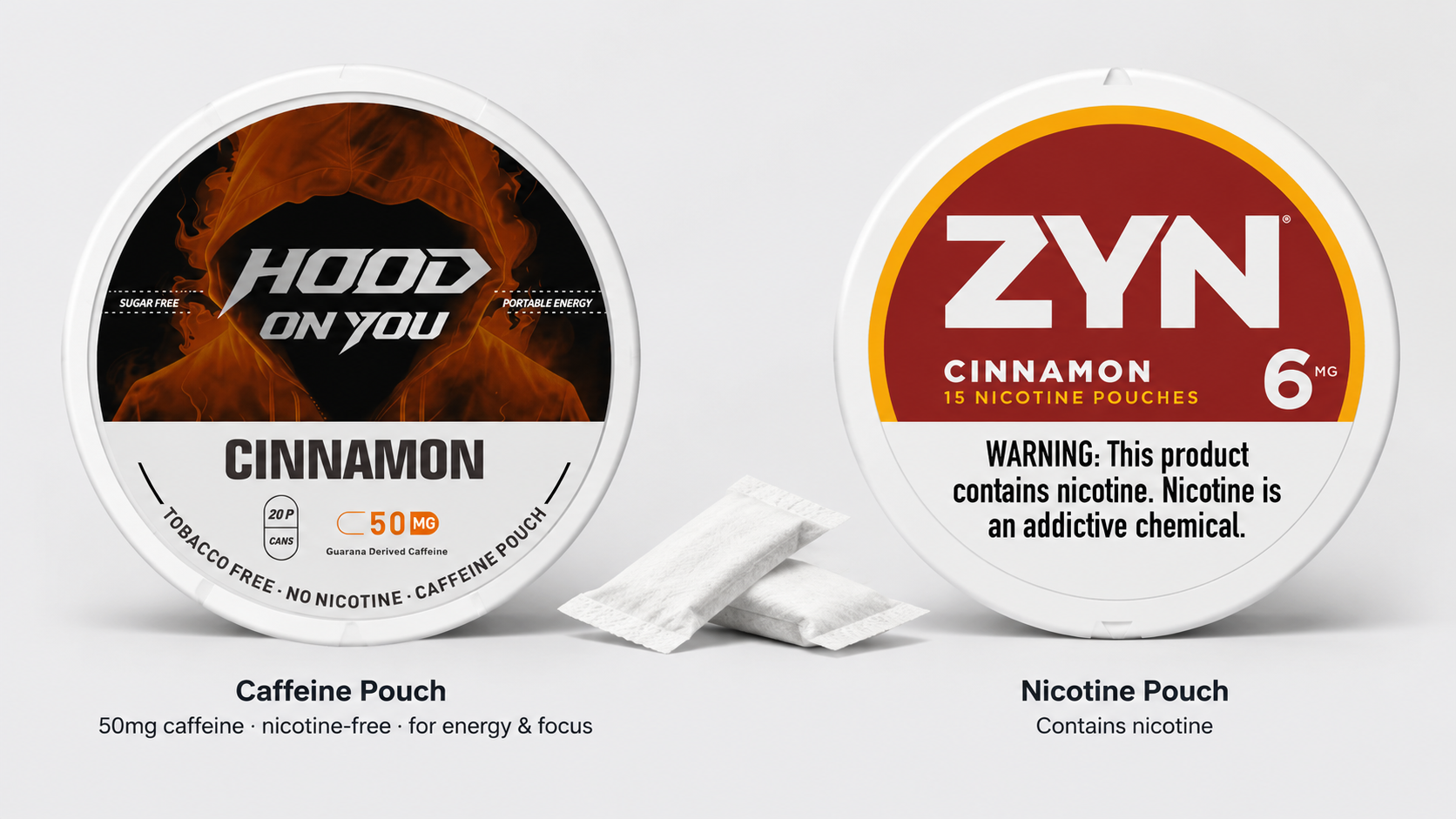
Both are small pouches hidden under the upper lip, but the substances they deliver are completely different. Zyn provides nicotine, a substance that can make people physiologically dependent. Caffeine pouches provide caffeine, a stimulant, which produces mild tolerance but does not stimulate the brain’s reward circuit like nicotine. The caffeine pouches vs Zyn question is really a question about which part of the habit you were using. If you rely on concentration and that twenty-minute break, caffeine pouches can meet most of your needs. But if you rely on nicotine, caffeine pouches can’t meet them, and pretending that caffeine pouches can also meet these needs is the reason why people start to rely on Zyn again within a week.
The difference seems to be obvious when written down. But in fact, this is the most common mistake most people make when switching to quitting smoking, and it also explains why some people can stick to it, while others give up on Thursday. It is also the reason a useful caffeine pouches vs Zyn comparison has to start with mechanism rather than price. Once your body is physiologically dependent on nicotine, no caffeine product can relieve withdrawal symptoms. Caffeine pouches are just a substitute for a habit, not a way to treat nicotine dependence.
Below is the full caffeine pouches vs Zyn breakdown: what are the differences, how much will these differences cost you, and which habits can be neatly transferred.
The fastest way to see where caffeine pouches vs Zyn actually separate is to put the numbers next to each other.
| Feature | Zyn (nicotine pouch) | HoodOnYou (caffeine pouch) |
| Active ingredient | Nicotine (3 mg or 6 mg per pouch) | Caffeine (50 mg per pouch) |
| Drug class | Nicotine receptor agonist | Adenosine receptor antagonist |
| Onset | 5–10 minutes | 10–20 minutes |
| Duration | 30–45 minutes | 20–45 minutes of wear; effects 2–4 hours |
| Dependence | Physical dependence, withdrawal on stopping | Mild tolerance; withdrawal is headache and fatigue for 1–3 days |
| Cardiovascular load | Raises heart rate and blood pressure; constricts blood vessels | Mild, dose-dependent increase in heart rate |
| Effect on gums | Vasoconstriction reduces blood flow to gum tissue | No established vasoconstrictive mechanism |
| Cost per pouch | Roughly 0.40–0.50 | About 0.22–0.25 |
| Pouches per can | 15 | 20 |
| Age restriction (US) | 21+ | No federal minimum; we sell to 21+ only |
| Contains tobacco | No (synthetic nicotine) | No |
| Contains nicotine | Yes | No |
Two lines in that table deserve more than a table cell.
The pouch format is where the caffeine pouches vs Zyn confusion starts. In the caffeine pouches vs Zyn matchup, both products are absorbed the same way: the active ingredients enter the blood circulation through the mucous membrane between the upper lip and the gums, bypassing the digestive tract, which is also the reason why they take effect much faster than drinks. Ordinary coffee is first digested in the stomach and then absorbed through the intestines. It usually takes 30 to 45 minutes to achieve the best results. A pouch starts working in 10–20 minutes. For a full breakdown of onset and duration, see how long caffeine pouches last.
Sublingual and oral mucosal administration is not a “health gimmick”; this method has been used in the medical community for decades, from nitroglycerine tablets to certain antiemetic drugs. The mechanism of action has long been clear, and the only difference is that the materials delivered are different.
Nicotine can bind to nicotinic acetylcholine receptors in the brain to activate the reward pathway and promote the release of dopamine. This is the mechanism behind addiction: the brain slowly expects this stimulus; once the stimulus is interrupted, withdrawal symptoms will appear, such as irritability, distraction, and sleep disorders. The way caffeine acts is different. It works by blocking adenosine receptors, which is why it can keep you awake — adenosine is a molecule that gradually accumulates in a day and makes you feel tired. Caffeine does not form a “reward-loop” dependence like nicotine. Although caffeine will produce tolerance — that is, after long-term use, the lifting effect of the same dose weakens; when it is suddenly discontinued, it may also cause withdrawal headaches that last for a day or two — this is essentially different from nicotine addiction. If you plan to get rid of nicotine dependence by switching products, you must distinguish the differences between the two.
Here is where the caffeine pouches vs Zyn difference becomes practical rather than academic: a pouch can replace the ritual and the alertness, and it cannot replace the nicotine. If you use Zyn mainly to get that sense of ritual and refreshing, this conversion process may be surprisingly smooth and almost without hindrance. If you were chasing the nicotine hit itself, it won’t — and pretending otherwise sets you up to relapse.
Most relevant content has avoided the most critical point, and we directly cut into the core:
The caffeine pouch is not a nicotine withdrawal product. This kind of product has not been evaluated by the U.S. Food and Drug Administration (FDA) and has not been approved for nicotine withdrawal treatment. Regular and responsible brands will not claim that it has this effect. If you have a physiological dependence on nicotine, the proven effective regimen includes nicotine replacement therapy (patches, chewing gum, tablets, etc.), prescription drugs, and behavioural and psychological support. Simply put, caffeine pouches are more suitable for adjusting caffeine-related intake habits. You can refer to the following suggestions to complete the habit conversion smoothly:
If you want the fuller safety picture, including blood pressure, pregnancy and medication interactions, our caffeine pouch safety guide covers it, and it is worth reading before you build a daily habit rather than after. It is also the part of the caffeine pouches vs Zyn conversation that most brand pages skip.
The caffeine pouches vs Zyn decision comes down to a fairly narrow question: which part of the product were you actually using? The people who do well tend to share a profile.
One more group worth naming: athletes and people in drug-tested settings. Nicotine’s effects on heart rate and fine motor control are a real performance cost, and some sports organizations have moved to restrict nicotine pouches. Caffeine, at moderate doses, is on the permitted list for essentially every major anti-doping framework. That is a legitimate reason to switch that has nothing to do with addiction.
Whichever side of the caffeine pouches vs Zyn decision you land on, five things separate a well-made product from a careless one:
HoodOnYou pouches are 50 mg caffeine, 20 per can, zero sugar, zero calories, no nicotine, no tobacco, in four flavors — Cool Mint, Wintergreen, Zesty Citrus and Cinnamon. If you are not sure which flavor you would actually use daily, the 5-flavor sample pack exists precisely for that question. If you have settled on a flavor and just need stock, our guide to where to buy caffeine pouches covers shipping across the US and Canada.
None of that checklist is unique to HoodOnYou: it applies to caffeine pouches vs Zyn and to every other brand on the shelf. If the reason you are reading a caffeine pouches vs Zyn comparison at all is that you are tired of arranging your day around a substance, that is the thing the brand was built around: focus as something you own rather than something you chase.
Caffeine pouches vs Zyn: can one really replace the other? If the purpose is to satisfy a certain sense of ritual or to stay awake, caffeine pouches are largely effective; but if the purpose is to obtain nicotine, they are ineffective. The caffeine pouches does not contain nicotine, which cannot relieve the discomfort caused by nicotine withdrawal. If you have become addicted to nicotine, you should understand that it is only an alternative carrier for the original use action. It can be used with a standard smoking cessation program, but not as a method of quitting smoking alone.
Do caffeine pouches show up on a drug test? Routine workplace drug screening usually targets substances such as amphetamine, opioids, cannabis, cocaine, and phencyclidine (PCP). Caffeine is not on them. Nicotine is tested separately and only when an employer specifically requests it, which is increasingly common — and is itself a reason some people switch. Nothing about caffeine pouches vs Zyn changes that.
How many caffeine pouches can I use in a day? Referring to the standards provided by the U.S. Food and Drug Administration (FDA), healthy adults are recommended to consume no more than 400 milligrams of caffeine per day. Converted to 50 mg caffeine pouches per pouch, this means that up to 8 pouches can be used, provided that no other caffeine sources such as coffee, tea, or soda are consumed. Most people land at two to four. Count everything, not just pouches. For the full dose math, see how much caffeine is in a pouch.
Will I get dependent on caffeine pouches the way I was on Zyn? Caffeine pouches and Zyn create dependence in different ways. Tolerance to caffeine develops; if use is stopped, a mild withdrawal headache may occur, usually disappearing within one to three days. There is no reward loop comparable to nicotine, which is the part of the caffeine pouches vs Zyn difference most people notice first after switching.
Can I use a caffeine pouch and a Zyn at the same time? You can, and some people do during a taper, but there is no reason to. When nicotine and caffeine are superimposed, the two together increase the heart rate and blood pressure, and the effect is more obvious than ingesting one of them alone, and it is difficult for you to distinguish which component the changes in the body come from.
Are caffeine pouches bad for your gums? Long-term use of nicotine pouches is easy to cause oral problems: nicotine will cause vasoconstriction, and the blood supply to the gums will become less over time. Caffeine does not have such a principle of action. Of course, as long as the bag is attached to the gums for a long time, it may cause slight physical friction stimulation. Therefore, it is recommended to rotate the left and right gums, and the single wearing should be controlled within 45 minutes, and should not be placed for several hours in a row. If the gums are abnormal and have not improved, remember to see a dentist in time.
In the caffeine pouches vs Zyn comparison, the two products share a shape and nothing else. One category is nicotine products with addictive mechanisms, and the other category is caffeine products for which dosage intake requires attention.
If the plan is to give up nicotine, it is worth asking frankly: was Zyn relied upon previously because of the nicotine in it, or simply because of the habit of holding a small pouch? If it was the focus and the twenty-minute break, a 50 mg caffeine pouch will feel like a clean swap at roughly half the cost of Zyn. If it was the nicotine, the pouch is a helpful piece of a plan — not the plan.
Either way, the caffeine pouches vs Zyn takeaway is the same: count your milligrams, and be honest about which drug you were buying. That is the one habit worth keeping.
This article is for general information and is not medical advice. HoodOnYou pouches contain caffeine, a stimulant. This product is not suitable for people under the age of 21, pregnant women, lactating women, and caffeine-intolerant people. If you have cardiovascular disease or are taking other drugs, you must consult professional medical staff before using them.
Caffeine Pouch Price Comparison: What 50 mg Actually Costs in 2026 The caffeine pouch price question looks simple, and it isn’t, because almost every brand
Caffeine Pouches vs Zyn: What Is Actually Different Both are small pouches hidden under the upper lip, but the substances they deliver are completely different.