Energy Academy
Caffeine Pouch Price Comparison: What 50 mg Actually Costs in 2026
Caffeine Pouch Price Comparison: What 50 mg Actually Costs in 2026 The caffeine pouch price question looks simple, and it isn’t, because almost every brand

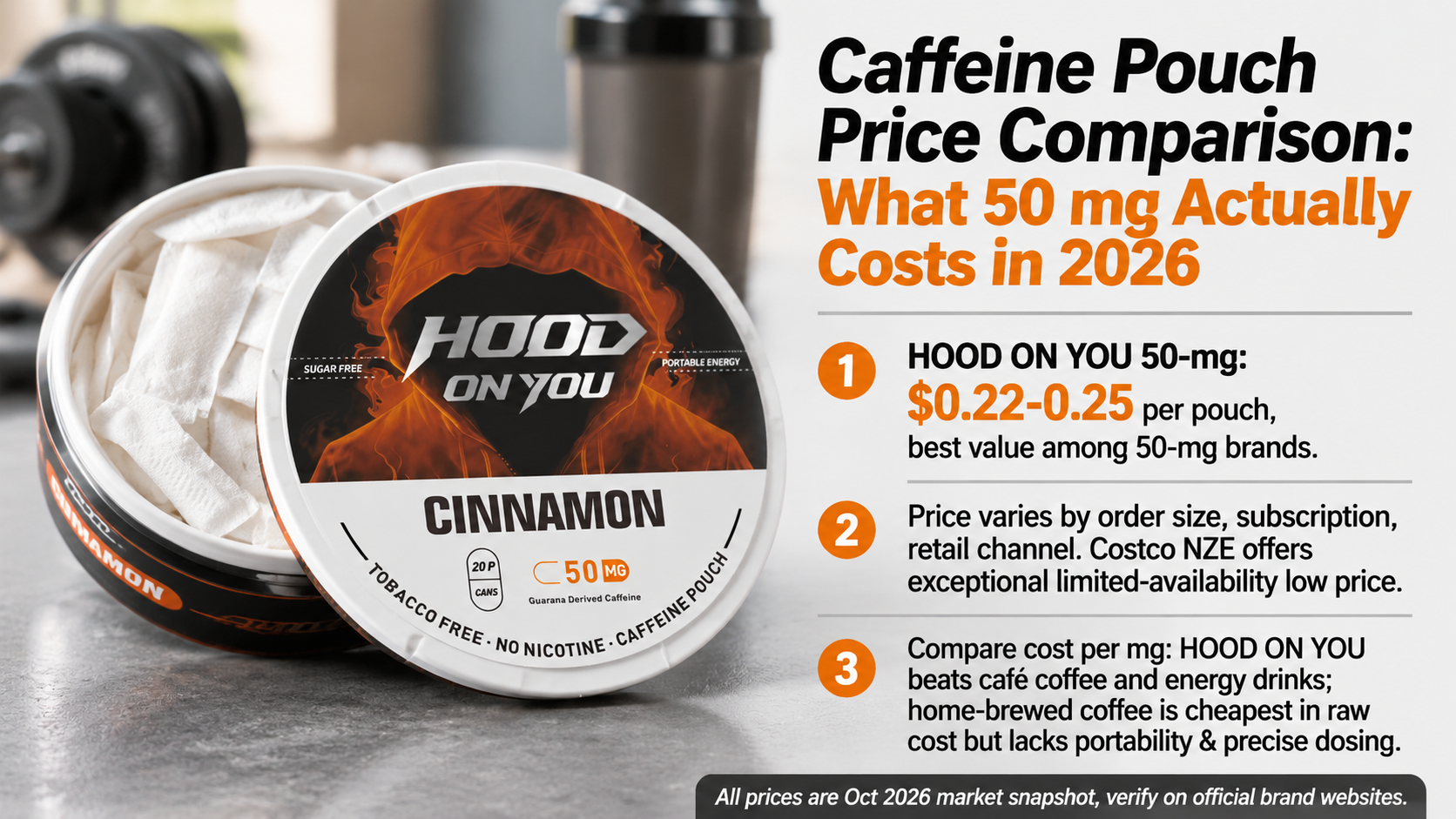
The caffeine pouch price question looks simple, and it isn’t, because almost every brand quotes the price of a can while cans hold anywhere from 15 to 25 pouches. A $6 can of 15 costs more per pouch than a $6 can of 20, and neither tells you what you will actually spend in a month. This page does the math the shelf label skips: the caffeine pouch price per pouch, per milligram of caffeine, and per day for the eight brands people actually compare, with our own numbers included so you can check us against everyone else.
One warning before the tables. Prices in this category move constantly. Every figure below was pulled from brand sites and independent reviews in October 2026, and several of those reviews noted that the same numbers had changed twice within the year. Treat this as a snapshot, not a quote. Verify on the brand’s own page before you order anything, including ours.
This is the caffeine pouch price landscape as of late 2026, sorted by dose.
| Brand | Caffeine per pouch | Pouches per can | Typical price | Caffeine pouch price per pouch |
| HoodOnYou | 50 mg | 20 | about $4.40–5.00 per can | $0.22–0.25 |
| Grinds Coffee Pouches (50 mg line) | 50 mg | 18 | $17.95 for 3 cans | $0.33 |
| Grinds Energy (80 mg) | 80 mg | 18 | $0.31–0.44 per pouch in bulk | $0.31–0.44 |
| NZE Energy | 50 mg | 15 | $34.99 for 5 cans | $0.47 (0.37 on subscription) |
| Bravo Energy | 50 mg | 15 | $7.49 per can | $0.50 (0.42 at 6 cans) |
| TeaZa Energy | 50 mg | 25 | $9.99 per bag | $0.40 |
| Wip Everyday | 100 mg | 15 | $7.99 per can | $0.53 |
| Ultra Focus | 100 mg paraxanthine | 15 | $38.00 for 3 cans on Amazon | $0.84 |
Two things jump out of that caffeine pouch price table, and one of them is ours. At 50 mg, HoodOnYou has the lowest caffeine pouch price of any brand listed, and it is not close: $0.22 to $0.25 against a field that mostly sits between $0.33 and $0.50. The other thing is Costco. Third-party reviewers tracking NZE found 6-can boxes in Costco warehouses between $9.97 and $14.97, which works out to roughly $0.11 to $0.17 per pouch and demolishes every number above. If you have a membership and your local warehouse stocks them, that is the single best deal in the category right now, and honesty requires saying so even though it undercuts us. It is also a reminder that any caffeine pouch price list, including this one, is only part of the picture.
Just looking at the “cost per pouch” cannot fully reflect the problem, because “pouch” is only a form of packaging, not a dosage unit. For example, a pouch of a product containing 100 mg of caffeine is priced at $0.53, while a pouch of a product containing 25 mg of caffeine is sold for $0.27 – although the former is twice the price of the latter, the former is actually more cost-effective. If the price of a caffeine pouches product is divided by the number of milligrams of caffeine it contains, the ranking will change, and sometimes it will even change significantly.
| Product | Caffeine pouch price per pouch | Cost per mg of caffeine |
| HoodOnYou 50 mg | $0.22–0.25 | about $0.0044–0.0050 |
| Grinds Energy 80 mg (bulk) | $0.31 | about $0.0039 |
| Wip Everyday 100 mg | $0.53 | about $0.0053 |
| Grinds 50 mg line | $0.33 | about $0.0066 |
| TeaZa 50 mg | $0.40 | about $0.0080 |
| NZE 50 mg | $0.47 | about $0.0094 |
| Bravo 50 mg | $0.50 | about $0.0100 |
| Ultra Focus 100 mg | $0.84 | about $0.0084 |
Now the honest part. Grinds’ 80 mg Energy pouch, bought in bulk at the low end of its range, beats us on cost per milligram. Among the products listed on this page, our “50 milligrams per pouch” product has the lowest price, but in terms of the unit price of “caffeine per milligram”, it is not the cheapest among similar products. If you consider it purely from an economic point of view, and the single intake you recognise is 80 mg, then another product may be more suitable for you. However, choosing the 80 mg specification means that you sacrifice flexible control over intake – 80 mg per pouch, equivalent to one-third of the U.S. Food and Drug Administration (FDA) recommendation of 400 mg per day, and the brand does not offer smaller dose options. In contrast, for a 50 mg product, using three pouches is 150 mg; for most people, this dose is easier to control – especially when you still drink coffee that day.
Same format, same drug, same 15-to-20-pouch can, and the caffeine pouch price still ranges from $0.22 to $0.84 per pouch. Four things explain most of the spread.
Can size is the quiet variable behind the caffeine pouch price. NZE’s $34.99 five-pack looks expensive until you notice it is the minimum order, not a price difference; their per-can figure only looks high because they refuse to sell one can online. Brands that sell single cans, like Bravo at $7.49, let you pay a premium for flexibility. Subscription pricing is the second factor, and it routinely knocks 15 to 25 percent off: NZE drops from $0.47 to $0.37, Bravo’s bundle ladder steps down from $0.50 toward $0.38, and most brands run similar programs. Third, the formula. Pouch products with cognitive-enhancing ingredients added to caffeine, such as NZE’s Alpha GPC and L-theanine mixture or Ultra’s paraxanthine, are more expensive than pure caffeine products. And whether this premium is worth it depends on how much you trust the undisclosed dosage of ingredients. Fourth, retail channels. Costco’s NZE product case is more convincing than any argument: the price of the same product in Costco stores is about $0.11 per pouch, while the price of similar competing products online is as high as $0.84 per pouch. Purchasing channels can affect the price of caffeine pouches more than brands, so the first price you see is often not the price you finally pay.
If the only purpose of the search is to find the cheapest caffeine pouches products, then the following is an objective ranking based on the actual situation rather than brand loyalty. Every caffeine pouch price below was cross-checked the same way as the table above.
Cheapest single purchase at 50 mg: HoodOnYou, at roughly $4.40 to $5.00 for a 20-pouch can, no subscription and no minimum order attached. Cheapest committed subscription at 50 mg: NZE at $0.37 per pouch, if you are willing to take five cans at once. Cheapest bulk at 50 mg: Bravo’s 10-can tier at about $0.38, or our wholesale tier, which brings 20-can orders down to about $0.21 per pouch. Cheapest of all, with an asterisk: NZE at Costco, around $0.11 to $0.17 per pouch, if a warehouse near you carries it. And cheapest per milligram in bulk: Grinds Energy at 80 mg, with the dose-control trade-off described above. That is the full spread of the caffeine pouch price range as 2026 closes.
One caution about chasing the bottom of the caffeine pouch price range, because a low number can hide a low count. A caffeine pouch price only means something next to the dose it delivers, the pouch count behind it, and whether the label prints milligrams at all. A no-name pouch at $0.15 that hides its caffeine content behind an “energy blend” is not cheaper, it is unmeasurable. The label rule from our what to check before you buy list applies double when price is the deciding factor.
The comparison that actually decides most purchases is not pouch against pouch. It is pouch against what you already drink.
| Source | Typical dose | Typical price | Cost per mg |
| Coffee shop drip (12 oz) | about 180 mg | $3.50–4.50 | $0.019–0.025 |
| Energy drink (16 oz) | about 160 mg | $2.50–3.50 | $0.016–0.022 |
| HoodOnYou 50 mg pouch | 50 mg | $0.22–0.25 | $0.0044–0.0050 |
| Home-brewed coffee | 80–120 mg per cup | varies with the bean | lowest of all |
Against a $4 cafe habit, the caffeine pouch price is not a rounding error, it is a different category entirely. Three pouches a day at our pricing runs about $0.70, or roughly $21 a month. The same alertness from a coffee shop runs closer to $12 a day and $360 a month if you are buying one cup per workday and covering the afternoon with a second. Energy drinks sit in between on cost and add 30-plus grams of sugar in the regular versions, which is the part of the energy drink equation our zero-sugar format was built around.
Home-brewed coffee still wins on pure economics, and we will not pretend otherwise. A bag of beans spread across a month makes each cup cost pennies per dose. What coffee cannot do is ride in a pocket, work in a meeting with no cup and no counter and no exit, or deliver a measured 50 mg that you can count against the FDA’s daily ceiling. That is what the caffeine pouch price is actually buying: measurement and portability, not just the caffeine. Price per milligram is one axis. Convenience is the other, and it is the reason the pouch category exists at all. Our guide to caffeine contents in pouches walks through the full dose math.
Why do caffeine pouch prices differ so much between retailers? Channel, more than brand. The same NZE can that costs $0.47 per pouch in a five-pack online has been tracked as low as $0.11 in Costco warehouses. Subscription programs typically take another 15 to 25 percent off. Before comparing brands, compare the channel each brand actually sells through, because that variable moves the caffeine pouch price further than any formulation difference.
Is a more expensive caffeine pouch better? Not automatically. The premium usually buys nootropics, flavor development, or retail availability, not more caffeine. Check whether the label prints the milligram dose of every active ingredient. A pouch that discloses 50 mg of caffeine and nothing else is easier to dose than a pricier one hiding an “energy blend,” regardless of what it costs.
How much should I expect to spend per month on caffeine pouches? At two to four pouches a day, which is where most users settle, a $0.22 to $0.25 pouch runs $13 to $30 a month. The same habit at a $0.50 pouch runs $30 to $60. The caffeine pouch price gap compounds quietly, which is why the per-pouch figure, not the per-can figure, is the number to compare.
Is a premium pouch worth its caffeine pouch price? Only if the premium buys something you can verify. Nootropic blends are the usual justification, and the ones we checked do not publish the milligram amount of each supporting ingredient, which means you are paying extra for an unknown. A fair rule: pay more for a printed dose you can count, not for a longer ingredient list.
Does the advertised caffeine pouch price include shipping? Sometimes not, and it changes the math. Brands with a can minimum, like NZE’s five-pack requirement, often cross a free-shipping threshold at the same time, which softens the commitment. Single-can brands charge full shipping on a small order, so the effective caffeine pouch price per pouch can run 10 to 20 percent higher than the sticker once freight is added. Check the threshold before you compare two brands against each other.
Do higher-dose pouches cost less per milligram? Usually, yes. Wip’s 100 mg pouch at $0.53 costs about $0.0053 per milligram, and Grinds’ 80 mg bulk pouch undercuts most of the 50 mg field. The trade-off is step size: with no pouch smaller than 80 or 100 mg, you lose the ability to take a half dose on a light day. Whether that suits you depends on how steady your caffeine schedule is.
The caffeine pouch price you should care about is the one on the right side of these three equations: dollars per pouch, dollars per milligram, dollars per day. Per can is marketing. Per pouch is comparison. Per milligram is honesty. Almost no brand advertises its caffeine pouch price that way, which is the reason this page exists.
As of late 2026, the caffeine pouch price field at 50 mg runs from $0.22 to $0.50 per pouch, and we are at the bottom of it with a 20-pouch can, a printed milligram dose, and no subscription required to get that price. If you want to test the format before committing to a can, the 5-flavor sample pack exists for exactly that. Sample first, then judge the caffeine pouch price per day on your own habit rather than on a brand’s assumption. If you have settled on a flavor and just want the best per-pouch number we offer, the wholesale page covers bulk pricing, and our where to buy guide explains shipping across the US and Canada.
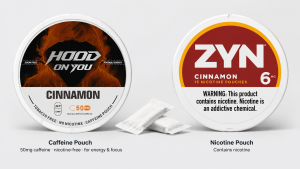
And if you are weighing pouches against the thing you currently drink or dip, the caffeine pouches vs Zyn comparison covers the nicotine side of that decision, and our caffeine pouch safety guide covers the health side. Price is a good reason to switch. It is rarely the only one worth checking.
Prices in this article reflect figures published on brand websites and in independent reviews as of October 2026 and change frequently. Verify current pricing before purchasing. This article is general information, not medical or financial advice. HoodOnYou pouches contain caffeine, a stimulant, and are not for anyone under 21, pregnant or breastfeeding individuals, or people sensitive to caffeine.
Caffeine Pouch Price Comparison: What 50 mg Actually Costs in 2026 The caffeine pouch price question looks simple, and it isn’t, because almost every brand
Caffeine Pouches vs Zyn: What Is Actually Different Both are small pouches hidden under the upper lip, but the substances they deliver are completely different.